|
Click Here to E-Mail To A Friend ||
How Can We Help You? Call 1-866-953-4769 ||
About Us
INDUSTRY EDITION
August 19, 2010
www.knowledgebureau.com
|
| Quote of the Week "Ignorance is dangerous, but knowledge without responsibility is more dangerous." Bruce B. Clark
|
|
|
BREAKING NEWS |
|
► GST Could Still Apply to Financial Services |
|
► Corporate Owner-Manager Compensation: Income Analysis Leads To Wise Investment |
|
► Short of Cash - Look To Payroll Department For A "Raise" |
| |
| YOUR NEWS |
| ► Poll Question: Do you feel that the economy has stabilized since the beginning of 2010? |
|
|
|
|
|
|
| GST Could Still Apply to Financial Services |
Are the services you provide to your clients GST-taxable? If you are not sure, you might be interested in a revised notice CRA issued in June regarding the application of GST on the delivery of financial services. Notice 250 - Proposed Changes to the Definition of Financial Services defines when GST is required to be charged on financial services and contains several lengthy examples outlining the obligations of investment managers, full service brokers and financial intermediaries like mutual fund sales people. The rules have left much to interpretation of facts, and this has advisors worried, rightly so.
In general, financial services, as defined in subsection 123(1) of the Excise Tax Act (the Act) are exempt. This includes the sale of insurance policies and trailer fees. However, the proposals specify that the following services are not financial services and therefore taxable:
- asset management services;
- credit management services; and
- certain services that are preparatory to or provided in conjunction with a financial service.
Although paragraph (q) of the definition of financial service is not directly amended, its scope will be clarified by the proposed addition of new definitions of the terms "asset management service" and "management or administrative service" to subsection 123(1) of the Act. What is important, according to the Notice, is that " asset management services, provided to an investment plan, or any corporation, partnership or trust whose principal activity is the investing of funds, are considered to be management or administrative services and therefore excluded from the definition of "financial service".” That means, they are taxable.
An investment plan includes a trust governed by:
- a registered pension plan;
- a registered retirement savings plan;
- a registered education savings plan; and
- a mutual fund trust
Example 4 in the notice discussed mutual fund sales: "The buying and selling of mutual fund units are supplies of financial services. In the course of providing services to clients and to the dealer, the mutual fund salesperson agrees to assist investors in purchasing, redeeming and exchanging units held in accounts. While the salesperson provides some services that are preparatory to a supply of a financial service, such as customer assistance, information and advice, the nature of the business and the degree of reliance by the dealer and the investor on the salesperson in effecting a supply of a financial service indicate that the services provided by the salesperson go beyond those that are merely preparatory. The services provided by the salesperson in these circumstances would be included in paragraph (l) as arranging for a financial service and not excluded by any of paragraphs (n) to (t) or proposed paragraphs (q.1) and (r.3) to (r.5). In other words, the activity would be defined as a financial service under subsection 123(1) of the Excise Tax Act and therefore, exempt from tax.
The notice goes on to explain that "it would be a question of fact as to whether the services provided in any particular case are considered to be a single supply that is made only in consideration of the commission on the purchase of the units or a combination of the commission on the purchase and the trailing commission. The facts and circumstances of each transaction would have to be considered on their own merits.”
Advisors should consult a qualified tax practitioner well versed in the new rules if they have any concerns about tax compliance.
We have created a table summarizing the taxable versus non-taxable services under the Excise Tax Act and the application of GST/HST in respect of "financial service". Contact us at reception@knowledgebureau.com if you are interested in a copy of the summary.
We would like to hear from you on this subject – what do these changes mean to advisors and their clients?
Educational Resources: For more information on tax planning provisions and compliance requirements subscribe to The Knowledge Bureau's online tax reference for taxpayers, financial advisors and their clients: EverGreen Explanatory Notes.
|
|
|
| |
| Corporate Owner-Manager Compensation: Income Analysis Leads To Wise Investment |
End of summer is a great time to review the income requirements of your family business clients. This is a prerequisite to any year end planning activities and required investment services to reduce and maximize after-tax income. Here are some tips to consider:
First, in determining the optimum tax efficient income plan, each individual family member's total income sources and their "tax timing” should be analyzed. The Knowledge Bureau's Tax Efficient Retirement Income Planning Course features an Income Analysis and Projection software tool that makes this process both fast and easy. It is important to ensure that every family member has enough total after-tax income or available cash flow to meet needs and wants. Family income splitting, which allows family members to fully utilize personal credits, and social benefit payments are most important planning factors.
Planning now for type of income to be earned coming into year end is critical, too. The payment of a reasonable salary, for example, will increase both net and taxable income. At lower income levels, it will also normally attract CPP and (often) EI contributions, both of which give rise to additional personal credits and may increase the family member's Canada Employment Credit. A decision to pay additional salary will increase net income for the purposes of calculating deductions like child care and credits like spousal and child amounts, medical and charitable donations. Keeping an eye on relevant net income thresholds is important and RRSP planning can help get desired tax minimization results. Therefore tax and investment advisors need to work together.
Remember that a salary is earned income for purposes of creating RRSP contribution room. If it is desirable to allow family members to accumulate more tax sheltered retirement income there may be a preference for paying a salary over a dividend, for example.
Dividend income, remember, increases both net income and taxable income as well, on an inflated basis, because it includes a gross up provision. That is later offset by the dividend tax credit, as part of the integration process between the corporate and personal tax systems. Therefore, issues that need to be taken into account in evaluating the payment of a dividend as compensation include:the taxable amount of the dividend is greater than the cash amount, so dividends have a greater effect on clawbacks than do salary, dollar for dollar:
- dividend income is not earned income and does not create RRSP contribution room;
- dividend income is investment income for purposes of computing the Cumulative Net Investment Loss account, and the receipt of a dividend may increase access to the capital gains deduction;
- dividends paid from a private corporation to a minor will normally attract the kiddie tax, meaning that they are taxed at the highest possible rate;
- because of the dividend tax credit, the tax treatment of the dividend must be modeled closely where the taxpayer has relatively low income and may be in danger of not utilizing all of his or her personal credits.
For more information on owner-manager tax planning, join us at our November Tax Planning Workshop: Year End Planning Strategies for Individuals and Business Owners - Focus On The Family Business. Link here for more details.
|
|
|
| |
| Short of Cash - Look To Payroll Department For A "Raise" |
Short of cash after a long summer off? Take a second look at your tax withholdings and quarterly tax instalment requirements (the next one coming up September 15). Many employees have deductions or credits available to them that are not reflected on the TD1 form; a review could create new cash. Retired? Remember that often pensioners, business owners and investors overpay instalments needlessly, too. If this is just the right time to invest after-tax dollars and the wrong time to be pulling capital out of the marketplace to make unnecessary tax prepayments, you'll want to review the amount you're paying in tax on income.
Employees: Where an employee has additional deductions or credits available this year, be sure to have the employer take these into account when calculating the tax to be withheld by redoing the TD1 Tax Credit Return. Reducing tax withheld at source enhances the employee's cash flow – amounts that would otherwise be received as a lump-sum refund when the tax return. Why wait for spring when the money could be working for you now? Convert overpaid taxes into an increase in the take-home paycheque received every pay period. If you find it unacceptable that the average tax refund was $1,400 per taxpayer in 2009, when that money could be working for you or your clients instead, act now.
Non-Statutory Deductions
Some deductions can be taken into account by the employer without having to obtain the consent of CRA. Others require a pre-authorization from CRA before the employer can take them into account and reduce withholdings.
Deductions that do not require Approval
- the employee's contributions to a registered pension plan,
- the deduction available to an employee who resides in a prescribed Northern zone,
- union dues,
- contributions to a Retirement Compensation Arrangement or certain other pension arrangements, and
- certain contributions to a Registered Retirement Savings Plan.
Deductions that Require Approval
An employee may have deductions or credits available other than those described above which will reduce the amount of tax he or she ultimately has to pay when the tax return is filed. The employee has the right to request that the employer take these into account in calculating the amount of income tax to withhold from net pay. However, the employee must first obtain the written permission of the Canada Revenue Agency.
Permission is requested by filling a Form T1213 with the CRA on which the employee identifies the employer and the dollar amounts of deductions or credits that will be available to reduce the amount of tax. If the CRA is in agreement, an authorization will be issued to the employer.
Next time: September 15 Instalment Payment Need Adjusting?
|
|
|
| |
|
|
| Knowledge Bureau Poll |
|
Current question Do you feel that the economy has stabilized since the beginning of 2010?  
|
Current poll results: Yes: 26% No: 74% Read what other readers have to say
|
|
| You Asked Us What Is A Qualifying Educational Program? |
| |
What are "qualifying education programs" for tax deduction purposes?
Qualifying educational programs (Full time): a program that lasts at least 3 consecutive weeks and requires a minimum of 10 hours of instruction or work in the program each week (not including study time). Instruction or work includes lectures, practical training, and laboratory work. It also includes research time spent on a post-graduate thesis. For 2010 the credit is $465 per month.
After 2003, a program taken by the student in connection with the student's employment duties, even if that student receives income from that employment, will qualify provided only that the employer does not reimburse the tuition cost. Prior to 2004, the opposite was the case: such programs did not qualify, whether the employer reimbursed the student or not.
Part-Time Students. For 2010 the credit is $140 per month. These may be claimed for each whole or part month in the year that the student was enrolled in a specified educational program at a designated educational institution. A specified educational program is a program that lasts at least 3 consecutive weeks and requires at least 12 hours of instruction each month.
Non-qualifying educational programs: Students who receive, from a person with whom he or she deals at arm's length, a grant, reimbursement, benefit, or allowance for that program do not qualify.
However, receipt of a scholarship, fellowship, bursary, or prize received, or any benefit received under the Canada Student Loans Act, Canada Student Financial Assistance Act, or the Act respecting financial assistance for education expenses of the Province of Quebec does not disqualify the education program.
In every edition of KBR we will answer questions that people have sent to us with respect to various tax issues. Feel free to send any questions you have to reception@knowledgebureau.com, and look for our response in an upcoming issue of Knowledge Bureau Report. |
|
|
| Opportunities for Employment in Bookkeeping |
| |
 |
We have some unique opportunities for bookkeepers and tax preparers at all levels of experience.
Please contact Shannon, Student Relations Coordinator, for more information at 1-866-953-4769. | |
|
|
| Follow Evelyn Jacks’ Blog: Your Money. Your Life. This Post: Claiming Tuition? |
| |
For people who want to think strategically about the role of money in their life.
Check the blog for recommended books and courses, calendar of events, and thought leadership.
Link to her blog by clicking here. |
|
|
| |
|
|
| OUR NEWS |
| Mark Your Calendar: DAC - Family Wealth Management |
You'll also want to take in the nearby Wizarding World of Harry Potter!
WestJet Special Fares
We are pleased to offer all delegates attending the Distinguished Advisors Conference on November 14-17, 2010 a 10% discount off of WestJet's regular fares at time of booking (excluding web and special fares). Attendees must make their travel arrangements through the WestJet specialty sales team 1-877-952-4696 and quote account # C6632. Discounted rates are available 3 days prior and 3 days after the event.
|
|
|
| Featured Faculty: Tax Efficient Retirement Income Planning |
 |
|
Of interest to accountants, bookkeepers, tax preparers and advisors, financial advisors and their teams. This leading edge program is designed to provide structure and process for advisors with an interest in specializing in tax-efficient retirement income planning. This is a skillset in great demand by Baby Boomers who seek expert solutions to their complex retirement planning needs and view tax erosion as the biggest threat to their wealth.
is part of the
View course brochure
until August 30, 2010
or call for personal assistance
(1-866-953-4769) |
Key skillsets include:
-
Be conversant with recent tax changes to personal, corporate and trust taxation;
-
Use the Net Worth Statement to structure the client's pre- and post-tax retirement income needs and monitor ongoing results;
-
Establish a long-term strategic "real wealth management” plan based on client needs, as well as after-tax capital preservation, growth and transition;
-
Establish action plans for long-term income planning around the specific phases of retirement;
-
Use business structures such as operating companies, holding companies and family trusts to develop retirement income plans;
-
Provide specific retirement income planning approaches for executives and understand tax-efficient strategic philanthropy.
|
|
|
| Featured Course: Master Your Retirement - Fulfill Your Dreams |
 |
|
How to Fulfill Your Dreams with Peace of Mind
In Master Your Retirement, author Doug Nelson shares simple principles that will help you take control of the financial decisions you need to make to relax and fulfill your dreams.
Historically "retirement" was seen as a one time event. Today "retirement" is a series of multi-year "phases". The challenge is to successfully transition from one phase to another. Adding to this complexity is the fact that each spouse may retire in a different way and at different times.
To Master Your Retirement you need to find solid solutions to three common questions:
- Will I have enough income?
- Can I do the things I want to do?
- If something unexpected occurs, will I be okay?
TARGET AUDIENCE:
Anyone who wants to make the most of their retirement dollars and take control of the retirement planning process. |
|
Price: $24.95 SAVE $10 if you buy before August 30th ONLY $14.95 |
|
THE KNOWLEDGE BUREAU is dedicated to publishing Newsbooks which provide financial education for decision-makers of all ages.
The MASTER YOUR ... series is written for everyday Canadians looking for sound answers—and the right questions to ask—concerning today's volatile marketplace.
Strategy. Process. Plan. Masterful Execution. Powerful Results.
|
|
|
| Featured Speaker: Don't Miss National Workshop Tour with Evelyn Jacks |
|
Media Passes Available: Contact The Knowledge Bureau toll free: 1-866-953-4769.
Join us for a concentrated, focused day on issues of concern to taxpayers, investors and professional planners in major centres across North America. At this time, we run workshops two times each year: January and November.
The Knowledge Bureau workshops are designed to be a solid investment of your time and money. The sessions begin with 8:00 a.m. registration, session begins promptly at 8:30, provide a one-hour break for lunch and end promptly at 4:00 p.m. They are structured to cover taxation topics in the morning and wealth management topics in the afternoon. |
|
 |
The dates are:
November Tax Planning Workshops:
Strategies for Individuals and Business Owners
Nationwide Workshop Tour Dates and Venues
| Date |
City |
Venue |
| November 3 |
Winnipeg |
The Manitoba Club |
| November 4 |
Calgary |
Coast Plaza |
| November 5 |
Vancouver |
Terminal City Club |
| November 8 |
Toronto Airport |
Crowne Plaza Toronto Airport |
| November 9 |
Ottawa |
Southway Inn |
January 2011 Annual Line-by-Line T1 Tax Update
Nationwide Workshop Tour Dates and Venues
| Date |
City |
Venue |
| January 11 |
Winnipeg |
The Manitoba Club |
| January 12 |
Calgary |
Coast Plaza |
| January 13 |
Edmonton |
Petroleum Club |
| January 14 |
Vancouver |
Terminal City Club |
| January 17 |
Toronto Airport |
Crowne Plaza AToronto Airport |
| January 18 |
Ottawa |
Southway Inn |
|
January 19
January 20 |
Montreal
London
|
TBA
The London Club |
|
|
|
| |
|
|
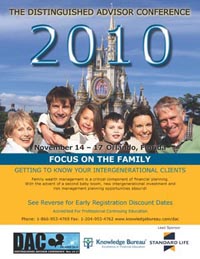
Distinguished Advisor Conference
November 14-17
Orlando, FL |
|
|
|
Call to register: 1-866-953-4769 to inquire |
|
DAC 2010 Sponsors |
|
LEAD SPONSOR  |
|
EXCLUSIVE MEDIA SPONSOR  |
|
Platinum Sponsor  |
|
Gold Sponsors


|
|
Silver Sponsor

|
|
Paper Sponsor
 |
|
Associate Sponsors 

| |
|
| Register by October 31 |
| |
 |
|
|