|
Click Here to E-Mail To A Friend ||
How Can We Help You? Call 1-866-953-4769 ||
About Us
INDUSTRY EDITION
September 1, 2010
www.knowledgebureau.com
|
| Quote of the Week "You can never cross the ocean unless you have the courage to lose sight of the shore.
" Christopher Columbus
|
|
|
BREAKING NEWS |
|
► Thought Leaders Gather To Focus On Family In Tough Times |
|
► More Deficits: Tax Revenues Down, EI Benefits Up |
|
► Tax-Free Savings Account - Our Poll Results |
|
► It's Back To School Time - What Qualifies For Tuition Amounts? |
| |
| YOUR NEWS |
| ► Poll Question: Do you feel that the economy has stabilized since the beginning of 2010? |
|
|
|
|
|
|
| Thought Leaders Gather To Focus On Family In Tough Times |
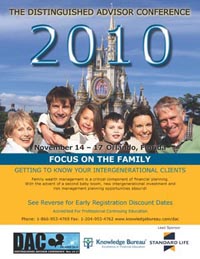
The Distinguished Advisor Conference November 14-17
Winnipeg, Manitoba. Influential thought leaders, executives and multi-disciplinary advisory teams from across the ranks in the Canadian financial services industry will gather November 14 to 17 at the Distinguished Advisor Conference to discuss family wealth management at a pivotal time in history, when a global economy is facing a series of difficult scenarios.
"The times are new, they are tough, and for some, they are scary,” says Evelyn Jacks, President, The Knowledge Bureau, founder and host of this event. "The best advisors and their associated firms need to know how to navigate families towards their best possible financial outcomes, as the developed world continues to experience the effects of significant change including deleveraging, recession, unemployment, lower tax revenues, and persistent challenges to a family's required investment returns.”
Twenty influential speakers will take the stage to help advisors plan strategically to take on the challenge of these and other key issues facing advisors today including:
- Robert Ironside, who will discuss how the end of the "Debt SuperCycle” will impact the wealth of families and their current investment strategies
- Richard Croft on how flat investment returns, and erosion of purchasing power will require new product solutions while Evelyn Jacks explains how tax and economic change impacts Real Wealth Management.
- Gordon Pape, on whether this is the right time to buy property—in Canada, Florida or other retirement havens
- Ron Thiessen, Debbie Hartzman and Enzo Calamo on how to broach the emotional impact of financial change on family structures
- Terri Williams, Louise Guthrie, Doug Nelson, Roland Chalupka, Alan Rowell and Lea Koiv on how planning can increase cash flow in lifecycle transition periods, particularly in retirement, health and estate planning
- Don Stewart, on how financial illiteracy affects the financial health of Canadians and what can be done by advisors to help
- Greg Pollock, Lisa Langley and Anthony Morris on how global economic change defines the new financial advisor and their family practices, with vital discussion on how to survive and thrive in hard times
- Paul Bates, Al Emid, Kish Kapoor and Mick Kelly on fostering successful relationships with families in good times and in bad. . . .Cont'd.
Early registration for the DAC is now possible, with a discount offered until September 30. The event takes place at the Hard Rock Hotel in Orlando; detailed information is available by phone at 1-866-953-4769 at www.knowledgebureau.com/dac.
Contact: Evelyn Jacks, President, evelyn@knowledgebureau.com
|
|
|
| |
| More Deficits: Tax Revenues Down, EI Benefits Up |
The Minister of Finance, The Honourable Jim Flaherty, has once again released the Fiscal Monitor, this time for the three months ending June 2010, announcing a deficit of $2.8 billion for the first quarter of the 2010-11 fiscal year, compared to a deficit of $5.0 billion for the same period ending June 2009. Although at first glance this looks like good news, we need to remember that for the same period in 2008 there was a budgetary surplus of $2.9 billion.
During the period personal and corporate income tax revenues were decreased by 3.4% and 5.1% respectively. Other revenues consisting of net profits and revenues from Crown corporations and returns on investments were down as much as 15%. EI premiums revenues were up $11 million, just under a 1% increase.
What does this mean to the average Canadian?
As discussed previously in the Knowledge Bureau Report, today's deficits are always of concern for several reasons: will they become the taxes of tomorrow? This is of particular significance to the ten million or so baby boomers who make up approximately one-third of our population and just under 50% of the tax filers, who may be concerned about the future purchasing power of what’s left of their retirement savings.
By the year 2011, the first boomers will reach age 65. Those aged 65 and over, according to Infrastructure Canada, are the most intensive users of the health care system, a financing burden yet to come for Canadian governments. What effects will this continued deficit spending by both federal and provincial governments have on public pensions and the health care system? How should elder Canadians prepare for higher costs of medical treatments, hospital care or the requirement for private home assistance resulting from an overburdened health care system?
A review of retirement income plans, critical health care plans, family succession and estate plans would be timely in an attempt to better understand financial needs for a future with less government capacity to assist and the possibility of increasing taxes on income or capital. What can be done today to plan for these uncertainties when returns on investments are minimal and inconsistent?
We would like to know your thoughts on the deficit, and what plans Canadians can make to prepare for the future.
Educational Resources: Now is a good time to review tax planning considerations and strategies for your clients. Consider the following Educational Resources available from The Knowledge Bureau:
|
|
|
| |
| Tax-Free Savings Account - Our Poll Results |
Do you think the rules for utilizing Tax-Free Savings Accounts are clear?
Final vote: Yes (31%) No (69%)
We had an overwhelming response to our July poll question regarding the TFSA rules and if the rules were clear to those that took advantage of the accounts. Almost 70% of the voters felt that the rules weren't clear, and with over 70,000 taxpayers having reviews of their TFSA transactions by CRA, we think your responses were right on the mark.
Here is a sampling of what we heard from our readers:
Margaret Tofflemire - No
It was not made clear enough that these were not really "Savings Accounts" to be used as regular bank accounts.
- No
The rules for TFSA are pathetically unclear. When TFSA first came out, it appeared that one could contribute up to $5,000/year, and take money out, put it back in to top back up to the $5,000/year limit, at will, as long as in 1 year, the total of all in/out transactions didn't exceed an 'end of the year' total of having over $5,000 for THAT year in your TFSA. This appears now, not to be their agenda.
Martin - No
All clients have some questions about TFSAs. Although the accounts themselves are a great idea, the government has not done a good job of explaining what they are, what their purpose really is, or how they work. Even for advisors, there is no one up-to-date official source that clearly and simply explains them. Plus they keep changing the rules. To keep up to date with valid knowledge, one must continually check to see if there have been changes or new info. And not all provinces allow beneficiaries - it should be consistent across Canada.
Maureen - Yes
For most clients, it takes a bit of searching and reviewing to decipher the rules, which is typical of anything new, but for tax advisors and financial institutions I think the rules are pretty clear. It just puts the onus on us to ensure our clients are advised well enough.
- Yes
Instead of trying to figure out how to overcontribute tax free, accountants should be focusing on legal tax strategies for their clients. There are always tax 'specialists' willing to push the envelope for clients who do not want to pay their fair share of taxes, for a fee .
Dan Allen - Yes
The rules are perfectly clear and my clients have not had an issue after we take the time to describe how TFSAs work. Clearly, TFSAs are not the same as savings accounts and should be used more as investment vehicles within a financial plan.
SANDRA GIBBS - No
The rules of excess contributions are not clear, particularly when there have been withdrawals. A better way to formulate these rules would be "$5,000 when contributed in the calendar year MUST be left in the plan until at least the following year when the new contribution amounts are published for the individual TFSA"
- No
Companies and investors seem to be confused by the lack of information from CRA on documentation that should be provided by the companies offering TFSA's to the investors. There is an critical need for standardized information on contributions and withdrawals.
And we'll let the final word go to:
Pete Coles - No
A lot of clients decided to switch their TFSA to an institution offering better rates without doing it directly or waiting until the end of the year. For this mistake they get penalized 1 per cent per month ($50 per month if they moved the entire $5,000). Yet they still only have a TFSA worth $5,000. They are essentially being taxed on a phantom excess contribution. I don't know if this was made clear or not but I fail to see the logic in it from the standpoint of tax policy.
The Editors of the Knowledge Bureau Report appreciate your feedback!
|
|
|
| |
| It's Back To School Time - What Qualifies For Tuition Amounts? |
In the next couple of weeks, as the children head back to school, we should give some thought to how to claim all those tuition fees that are being paid out to various educational institutions. Here is a review of the basic definitions for non-refundable credits and what qualifies for the tuition credit and education amounts:
TUITION FEES
Students may claim the fees paid for courses taken in the tax year. To qualify, each tuition fee must be more than $100. Eligible tuition fees include:
- Fees paid for courses at a post-secondary school level paid to a university, college, or other educational institution in Canada,
- Fees paid to an educational institution in Canada certified by the Minister of Human Resources Development for courses (if the student was 16 or older in the year) to develop or improve skills in an occupation,
- Fees paid for courses at a post-secondary school level paid to a university, college, or other educational institution in the United States if the student lived in Canada near the border throughout the year and commuted to the school, and
- Fees paid if the student was in full-time attendance at a university outside Canada, for courses that were at least 13 consecutive weeks long, and that will lead to a degree.
Other eligible fees include:
- admission fees,
- charges for the use of library or laboratory facilities,
- examination fees,
- application fees (but only if the student later enrolls in the institution),
- charges for a certificate, diploma, or degree,
- mandatory computer service fees,
- academic fees,
- the cost of any books that are included in the total fees for a correspondence course, and
- fees, such as athletic and health services fees, paid to a university, college, or other educational institution in addition to tuition for post-secondary courses, when such fees are required to be paid by all students. If not all students are required to pay them, then amounts eligible are limited to $250.
Non-qualifying tuition fees include:
Also, fees cannot be claimed if:
- they are paid or reimbursed by an employer, where the amount is not included in the employee's income,
- paid by a federal, provincial, or territorial job training program where the amount is not included in income, or
- the fees were paid (or are eligible to be paid) under a federal program to help athletes, where the payment or reimbursement has not been included in income.
NOTE: KNOWLEDGE BUREAU SELF STUDY COURSES QUALIFY!
|
|
|
| |
|
|
| Knowledge Bureau Poll |
|
Current question Do you feel that the economy has stabilized since the beginning of 2010?  
|
Current poll results: Yes: 26% No: 74% Read what other readers have to say
|
|
| You Asked Us Can I Deduct Interest Paid On Student Loans? |
| |
Can I deduct the interest paid on my students loan?
Taxpayers who pay interest on student loans under the Canada Student Loans Act, The Canada Student Financial Assistance Act or a provincial statute that governs the granting of financial assistance to students at a post-secondary level, may claim a non-refundable credit against taxes payable for the interest paid under Section 118.62 of the the Income Tax Act.
The amount is claimable on Schedule 1 Federal Tax Line 319. Although it is not transferable to another person such as a spouse or common-law partner, any credit not claimed in one year may be carried forward for up to five years.
For more tax tips, purchase a copy of Essential Tax Facts written by The Knowledge Bureau's President, Evelyn Jacks, to learn how to ace your 2009 tax return and save money all year long.
In every edition of Knowledge Bureau Report, we will answer questions that people have sent to us with respect to various tax issues. Feel free to send any questions you have to reception@knowledgebureau.com, and look for our response in an upcoming issue of KBR. |
|
|
| Follow Evelyn Jacks’ Blog: Your Money. Your Life. This Post: September 15th Instalments |
| |
For people who want to think strategically about the role of money in their life.
Check the blog for recommended books and courses, calendar of events, and thought leadership.
Link to her blog by clicking here. |
|
|
| Opportunities for Employment in Bookkeeping |
| |
 |
We have some unique opportunities for bookkeepers and tax preparers at all levels of experience.
Please contact Shannon, Student Relations Coordinator, for more information at 1-866-953-4769. | |
|
|
| |
|
|
| OUR NEWS |
| Mark Your Calendar: Don't Miss National Workshop Tour with Evelyn Jacks |
|
Media Passes Available: Contact The Knowledge Bureau toll free: 1-866-953-4769.
Join us for a concentrated, focused day on issues of concern to taxpayers, investors and professional planners in major centres across North America. At this time, we run workshops two times each year: January and November.
The Knowledge Bureau workshops are designed to be a solid investment of your time and money. The sessions begin with 8:00 a.m. registration, session begins promptly at 8:30, provide a one-hour break for lunch and end promptly at 4:00 p.m. They are structured to cover taxation topics in the morning and wealth management topics in the afternoon. |
|
 |
The dates are:
November Tax Planning Workshops:
Strategies for Individuals and Business Owners
Nationwide Workshop Tour Dates and Venues
| Date |
City |
Venue |
| November 3 |
Winnipeg |
The Manitoba Club |
| November 4 |
Calgary |
Coast Plaza |
| November 5 |
Vancouver |
Terminal City Club |
| November 8 |
Toronto Airport |
Crowne Plaza Toronto Airport |
| November 9 |
Ottawa |
Southway Inn |
January 2011 Annual Line-by-Line T1 Tax Update
Nationwide Workshop Tour Dates and Venues
| Date |
City |
Venue |
| January 11 |
Winnipeg |
The Manitoba Club |
| January 12 |
Calgary |
Coast Plaza |
| January 13 |
Edmonton |
Petroleum Club |
| January 14 |
Vancouver |
Terminal City Club |
| January 17 |
Toronto Airport |
Crowne Plaza AToronto Airport |
| January 18 |
Ottawa |
Southway Inn |
|
January 19
January 20 |
Montreal
London
|
TBA
The London Club |
|
|
|
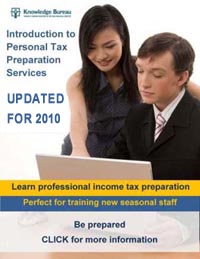
| Featured Faculty: Introduction to Personal Tax Preparation Services |
 |
|
Of Special Interest to Tax and Bookkeeping Services, Small Business Owners
Differentiate yourself with specialized knowledge in this growing area!
Fall is the best time to train to prepare personal taxes, in time for the busy tax season ahead. Learn how to prepare family tax returns, conduct a professional tax interview and plan tax reduction strategies.
is part of the
program.
View course brochure
until December 14th, 2010
or call for personal assistance
(1-866-953-4769)
|
|
|
|
| Featured Course: Master Your Real Wealth |
 |
Author: Erika Penner
How to live your life in financial security
Do you fear you will outlive your savings? Do you want better results from your investments? Then now’s the right time to Master Your Real Wealth!
To achieve peace of mind, today’s investor needs to make sharp decisions about scarce financial resources. This book will help bring understanding and process to building and managing your savings, so that you can focus on accumulating real wealth for the future. This book will help you answer three important questions:
- What can I do now to build my wealth for the future?
- How can I be better prepared to meet upcoming life events and my personal priorities despite uncontrollable obstacles and market volatility?
- How can I minimize taxes, inflation and the costs of investing to increase my income and the growth of my investments?
|
TARGET AUDIENCE:
Anyone who wants to break free of financial stress relating to the future of their money and achieve peace of mind. By better understanding the components of Real Wealth Management™, you can arrange your affairs to accumulate, growth and preserve wealth even in difficult markets and then focus on living your dreams.
ABOUT THE AUTHOR
 Erika Penner is an independent Certified Financial Planner with over 30 years of experience in the financial services industry. She also holds RPAC's Professional Retirement Planner designation as well as The Knowledge Bureau's MFA designation in Retirement & Estate Planning. Erika has been interviewed by the media on a variety of topics and has given presentations to professional groups such as Advocis, The Academy of Financial Divorce Specialists, RPAC and others. With her designations in retirement, Erika is placing greater emphasis in her practice on retirement transitions for boomers, of which she is one! Erika Penner is an independent Certified Financial Planner with over 30 years of experience in the financial services industry. She also holds RPAC's Professional Retirement Planner designation as well as The Knowledge Bureau's MFA designation in Retirement & Estate Planning. Erika has been interviewed by the media on a variety of topics and has given presentations to professional groups such as Advocis, The Academy of Financial Divorce Specialists, RPAC and others. With her designations in retirement, Erika is placing greater emphasis in her practice on retirement transitions for boomers, of which she is one!
Price: $24.95 SAVE $10 if you buy before November 16 ONLY $14.95 |
Buy Now |
THE KNOWLEDGE BUREAU is dedicated to publishing Newsbooks which provide financial education for decision-makers of all ages.
The MASTER YOUR ... series is written for everyday Canadians looking for sound answers—and the right questions to ask—concerning today's volatile marketplace.
Strategy. Process. Plan. Masterful Execution. Powerful Results.
|
|
|
| Featured Speaker: DAC - Family Wealth Management |
You'll also want to take in the nearby Wizarding World of Harry Potter!
WestJet Special Fares
We are pleased to offer all delegates attending the Distinguished Advisors Conference on November 14-17, 2010 a 10% discount off of WestJet's regular fares at time of booking (excluding web and special fares). Attendees must make their travel arrangements through the WestJet specialty sales team 1-877-952-4696 and quote account # C6632. Discounted rates are available 3 days prior and 3 days after the event.
|
|
|
| |
 |
| Register by October 31 |
| |
|
|
|
Distinguished Advisor Conference
November 14-17
Orlando, FL |
|
|
|
Call to register: 1-866-953-4769 to inquire |
|
DAC 2010 Sponsors |
|
LEAD SPONSOR  |
|
EXCLUSIVE MEDIA SPONSOR  |
|
Platinum Sponsor  |
|
Gold Sponsors


|
|
Silver Sponsor

|
|
Paper Sponsor
 |
|
Associate Sponsors 

| |
|
|