|
Click Here to E-Mail To A Friend ||
How Can We Help You? Call 1-866-953-4769 ||
About Us
INDUSTRY EDITION
August 5, 2010
www.knowledgebureau.com
|
| Quote of the Week " Education is the ability to meet life's situations." Dr. John G. Hibben
|
|
|
BREAKING NEWS |
|
► Withdrawing Cash From a TFSA? |
|
► Termination Checklist May Be Helpful To Employers |
|
► Is Your Cottage Your Principal Residence? |
| |
| YOUR NEWS |
| ► Poll Question: Do you think the rules for utilizing Tax-Free Savings Accounts are clear? |
|
|
|
|
|
|
| Withdrawing Cash From a TFSA? |
With back to school just around the corner and other money spending opportunities on the horizon, we thought it would be worthwhile to review the Tax-Free Savings Account (TFSA) rules to determine if it is worthwhile raiding the account for those upcoming cash requirements.
Here are the top 6 questions we receive regarding TFSA's:
1. What is a TFSA and Who Can Contribute To It?
Available since January 1, 2009, the new Tax-Free Savings Account (TFSA) is a registered account in which investment earnings, including interest, dividends and capital gains accumulate within the account on a tax free basis. Contributions up to an annual maximum of $5000 can be made by/for those who have reached 18 years of age and are residents of Canada. There is no maximum contribution age (you can be 92, for example!), however a tax return must be filed to build "TFSA Contribution Room”. This $5000 annual maximum amount will be indexed after 2009, with rounding to the nearest $500. The annual maximum remains at $5,000 for 2010 contributions.
2. How is TFSA Contribution Room Calculated? The TFSA contribution room is made up of:
· annual TFSA dollar limit ($5,000peryear plus indexation, if applicable);
· any unused TFSA contribution room in the previous year; and
· any withdrawals made from the TFSA in the previous year, excluding qualifying transfers.
3. Can unused contribution room be carried forward to future years?
Unused contribution room can be carried forward on an indefinite carry forward basis. This means two things: first if you have unused TFSA contribution room of $10,000, you can in fact carry that unused contribution room forward indefinitely to fund when you have the money. Secondly once you build contribution room, you can't lose it. That is, you can take the principal and earnings out of your TFSA—on a tax free basis--and spend it on whatever you want; then put it back – as long as you wait until you have the contribution room.
4. How can I keep track of my TFSA Contribution Room?
Based on information provided by the issuers, the Canada Revenue Agency (CRA) will determine the TFSA contribution room for each eligible individual and report this on the Notice of Assessment. Withdrawals, excluding qualifying transfers, made from a TFSA in the year will be added back to TFSA contribution room at the beginning of the following year.
5. What happens when I make an overcontribution?
Taxpayers cannot contribute more than their available TFSA contribution room in a given year, even if they make withdrawals from the account during the year. If they do, a penalty tax of 1% of the highest excess amount in the plan during the month, is charged, for each month you are in an overcontribution position. Discrepancies in contribution room limit or excess contributions, must be reported to the TFSA issuer. In addition, after October 16, 2009, any income earned resulting from an overcontribution, or a contribution to a prohibited or non-qualifying investment will be taxed at 100%.
For example, let's take Paul who contributed $5,000 to his TFSA in 2009, and another $5,000 in 2010. In mid 2010 he decided to take out $4,000 from his TFSA to put a deposit on a sports car he saw for sale on e-Bay. When Paul found out he couldn't import the sports car into Canada, he backed out of the sale and received his deposit back. Unfortunately, as Paul has already put his full TFSA maximum into the account, he no longer has contribution room. He will have to wait until 2011 to re-contribute all or part of the $4,000 withdrawal. If he does re-contribute during 2010 he would be subject to the penalty tax of 1% a month for each month the excess contribution is in the account.
6. What income sources should be earned from the TFSA account?
That largely depends on age and sources of other income. Those sources of income subject to the highest marginal tax rates (such as interest) or dividends, (which artificially inflate net income, thereby decreasing social benefits payments), should perhaps be earned within a TFSA. Capital gains and losses should perhaps be incurred outside the TFSA for better tax results, particularly if planned in combination with a charitable giving strategy. But if you are looking for the power of real tax free growth, the TFSA should contain a diversified set of investments, including equities.
Note that losses from investments earned within a TFSA are not deductible from capital gains held outside the account. In addition, transfers of assets held outside of a TFSA, which result in a capital loss at time of transfer are considered to be "superficial losses” which are not usable as a deduction against capital gains of the year.
|
|
|
| |
| Termination Checklist May Be Helpful To Employers |
Employers - in the very near future you will have many summer students leaving their jobs to head back to school, it's time to brush up on the rules related to "interruption of earnings" or what is more commonly referred to as a "termination of employment".
A termination checklist is useful in helping the payroll department to determine that all payments and all deductions are captured for the final pay. It can also be used to ensure that all internal policies relating to a termination have been complied with.
A record of employment (ROE) form is required by the government once an employee has a break in employment. The government uses the information on the ROE to determine whether a person qualifies for EI benefits, the benefit rate and the duration of his or her claim.
An ROE must be issued by an employer even if the employee has no intention of filing a claim for EI benefits.
An interruption in earnings could be due to the employee's quitting or the employer terminating the employment, but only arises if it involves or is expected to involve 7 consecutive calendar days without work or insurable earnings from the employer.
An interruption of earnings also occurs where a salary falls below 60% of normal earnings due to illness, injury, quarantine, pregnancy, the need for a parent to care for either newly born or adopted children, or the need to provide care or support to a family member who is gravely ill with a significant risk of death.
Special rules apply to casual workers. When a part-time or casual worker has not worked for 30 days, is no longer on the employer's active employment list or the employee or the government requests an ROE form, a form must be completed by the payroll department.
When an employee is terminated a termination letter is usually prepared by the payroll or human resource department which outlines the reason for the termination, monies owing to the employee and continuation of any benefits or other coverage. The letter should also describe any non-competition agreement terms and any other actions required by both the employer and the employee.
An employee may or may not work their notice of termination period – the period from the announcement that employment is terminated until the last day of work.
As noted above, if an employee chooses not to work their notice period, the employer generally does not have to pay the employee for the notice period. On the other hand, if an employer chooses not to have the employee work out their notice period then the employer must pay the employee for this period. As mentioned earlier in the course, this payment is referred to as "pay in lieu of notice".
Notice period rules vary by province and can be found in provincial labour standards.
Educational Resources: Excerpted from Advanced Payroll for Professional Bookkeepers, one of the courses that comprise the Bookkeeping Services Specialist program.
|
|
|
| |
| Is Your Cottage Your Principal Residence? |
Most of us are aware that principal residences are eligible for special tax status. Throughout the last 40 years there have been a number of changes to the rules surrounding principal residences, particularly those that are long-held (think family cottages), the historical changes are outlined below.
As an overview, a property qualifies as your principal residence if it meets the following conditions:
-
Is a house, cottage, condominium, apartment, trailer, mobile home, or houseboat.
-
Is owned by you alone or jointly with another person.
-
You, your spouse, your former spouse, or any of your children lived in it at some time during the year.
-
You designate your property as your principal residence.
Form T2091, Designation of a Propery as a Principal Residence by an Individual is used to calculate the capital gain portion.
The basic computation to calculate the exempt gain is as follows:
Total Gain X 1+ the number of years the home was designated as a principal residence
Total number of years you owned teh home after 1971
Historical changes
Special consideration must be given to the tax status of long-held residences in determining tax consequences of the various plans clients have:
• Pre 1972: No tax is payable on accrued gains on any capital assets
• 1972 to 1981: Prior to 1982 one principal residence designation was allowed for each year for each spouse. Therefore for these years a husband and wife can designate different principal residences (e.g. a house and a cottage) to help minimize capital gains (and taxes) on a sale.
1982 to date: Since 1982 you have been able to designate only one home as your family's principal residence for each year. If you are married or are 18 years or older your family includes you, your spouse, and your minor children. If you are not married or are under age 18, your family includes your mother and father and your brothers and sisters (unmarried and under age 18).
• 1993 to date: One principal residence designation allowed for each year to each conjugal relationship (married or common-law)
• 1994: Prior to February 23, 1994, everyone had a $100,000 personal capital gains exemption. This meant that every Canadian could generate up to $100,000 of capital gains during their lifetime (up to this date) and not pay tax on those gains. In order to get the final benefit from this exemption, many people elected, on form T664, to use up their exemption and trigger a capital gain. The election increased the adjusted cost base of particular assets owned at that time so that when the property was actually sold, the taxable capital gain was that much less. If you filed a T664, you are considered to have sold your capital property at the end of February 22, 1994, and to have immediately reacquired it on February 23, 1994.
• 1998 to 2001: Same-sex couples could elect conjugal status, thereby limiting their tax-exempt residences to one per unit
• 2001 to date: Same-sex couples are required to limit themselves one principal residence designation per year per conjugal relationship
|
|
|
| |
|
|
| Knowledge Bureau Poll |
|
Current question Do you think the rules for utilizing Tax-Free Savings Accounts are clear?  
|
Current poll results: Yes: 30% No: 70% Read what other readers have to say
|
|
| You Asked Us Alimony and Support: What Can I Deduct In The Year of Separation? |
| |
Can I claim the spousal amount and support payments in the year of separation?
Alimony or support payments made to a spouse or common-law partner are taxable to the recipient and deductible by the payor. In the year of separation or divorce, however, the payer may claim either the deduction for support or the spousal amount, but not both.
For more tax tips, purchase a copy of Essential Tax Facts written by The Knowledge Bureau's President, Evelyn Jacks, to learn how to ace your 2009 tax return and save money all year long.
In every edition of Knowledge Bureau Report, we will answer questions that people have sent to us with respect to various tax issues. Feel free to send any questions you have to reception@knowledgebureau.com, and look for our response in an upcoming issue of KBR. |
|
|
| Follow Evelyn Jacks’ Blog: Your Money. Your Life. This Post: Claiming Tuition? |
| |
For people who want to think strategically about the role of money in their life.
Check the blog for recommended books and courses, calendar of events, and thought leadership.
Link to her blog by clicking here. |
|
|
| |
|
|
| OUR NEWS |
| Mark Your Calendar: Perfect For CE Credits - KB National Workshop Tour with Evelyn Jacks |
|
Media Passes Available: Contact The Knowledge Bureau toll free: 1-866-953-4769.
Join us for a concentrated, focused day on issues of concern to taxpayers, investors and professional planners in major centres across Canada. At this time, we run workshops two times each year: January and November.
The Knowledge Bureau workshops are designed to be a solid investment of your time and money. The sessions begin with 8:00 a.m. registration, session begins promptly at 8:30, provide a one-hour break for lunch and end promptly at 4:00 p.m. They are structured to cover taxation topics in the morning and wealth management topics in the afternoon. |
|
 |
The dates are:
November Tax Planning Workshops:
Strategies for Individuals and Business Owners
Nationwide Workshop Tour Dates and Venues
November 3 - Winnipeg
November 4 - Calgary
November 5 - Vancouver
November 9 - Toronto East
November 10 - Toronto West
January 2011 Workshops
All Tax, All Day
Nationwide Workshop Tour Dates and Venues
January 11 - Winnipeg
January 12 - Calgary
January 13 - Edmonton
January 14 - Vancouver
January 17 - Toronto Downtown
January 18 - Ottawa
January 27 - Toronto East
|
|
|
| Featured Faculty: Introduction to Corporate Tax Preparation: A Great Resource to Train New Staff Members |
 |
|
Learn how to prepare a corporate tax return. With an understanding of the underlying business issues and tax options, you can help your clients minimize the amount of tax paid and identify planning opportunities in a timely fashion. This course provides the tax preparer with an understanding of the businesses issues and tax options that impact the taxation of corporate income, so that the return can be prepared accurately, tax is minimized and planning opportunities are identified on a timely basis.
View course brochure
until September 28, 2010
or call for personal assistance
(1-866-953-4769) |
Key skillsets include:
-
Basic tax planning concepts, both for the corporation and its shareholders;
-
How to print out the T2 jacket, complete the Identification section, compile GIFI, and prepare the S1, S2, S3, S4, S6, S7, S8, S10 schedules;
-
Review case studies in T2 preparation and assist owner-managers with simple planning scenarios;
-
Gain the knowledge and skills to bring great value to your clients and build your business at the same time!
|
|
|
| Featured Course: Master Your Taxes |
Master Your Taxes
Author: Evelyn Jacks
HOW TO MAXIMIZE YOUR AFTER-TAX RETURNS |
 |
Mastering your taxes involves two pain points: time and money! No one has a lot of time, yet that is what it appears to take to figure it out or understand it; worse it seems to need expensive professional advice to get it right. This book will help you sooth that pain by showing you simple principles to save time and money on your largest lifetime expense—taxes. |
KEY BENEFITS FOR AUDIENCE?
- Understand the real impact of taxes on your income and capital
- Learn to pay yourself first
- Know how to split income with family members
- Learn the basic principles of tax free and tax efficient investing
- Take advantage of tax deferrals
- Gather the right information
- Ask the right probing questions
- Structure your affairs—legally—to beat the taxman
- Annual Updating—cut through the details and make it work for you
|
|
TARGET AUDIENCE:
Anyone who wants to understand the tax implications of life choices and beat the fear of the unknown—a large and unexpected tax bill.
|
|
ABOUT THE AUTHOR
EVELYN JACKS, is an international speaker, educational publisher and best-selling author. This is her 42nd book, focused on the subject of personal tax, financial planning, leadership and team management in creating real wealth. She is well-known by millions as Canada's most trusted tax author and commentator on issues relating to tax and personal finance. She has participated as an advisor to governments on tax policy and design. |
 |
THE KNOWLEDGE BUREAU IS. . .dedicated to publishing Newsbooks which provide financial education for decision-makers of all ages.
The MASTER YOURS SERIES IS . .written for everyday Canadians looking for sound answers—and the right questions to ask—concerning today's volatile marketplace.
Strategy. Process. Plan. Masterful Execution. Powerful Results.
|
|
|
| Featured Speaker: Passion from Jim Gray; Nomination for David Christianson |
 Jim Gray Jim Gray, Knowledge Bureau faculty member and one of the presenters at our 2009 Distinguished Advisors Conference, has written a story called "Don't Love Your Job, Then It's Time For A Change" which appeared in the Globe and Mail on July 27th. To read the column, click here.
David Christianson, Knowledge Bureau faculty member and his team at Wellington West have been shortlisted for the 2010 STEP Private Client Awards in several categories. Congratulations Dave!
|
|
|
| Featured Book: DAC - Family Wealth Management |
You'll also want to take in the nearby Wizarding World of Harry Potter!
WestJet Special Fares
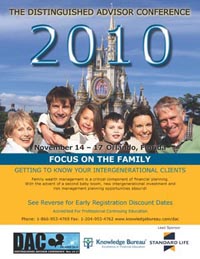
We are pleased to offer all delegates attending the Distinguished Advisors Conference on November 14-17, 2010 a 10% discount off of WestJet's regular fares at time of booking (excluding web and special fares). Attendees must make their travel arrangements through the WestJet specialty sales team 1-877-952-4696 and quote account # C6632. Discounted rates are available 3 days prior and 3 days after the event.
|
|
|
| |
| Register by October 31 |
| |
|
|
|
Distinguished Advisor Conference
November 14-17
Orlando, FL |
|
|
|
Call to register: 1-866-953-4769 to inquire |
|
DAC 2010 Sponsors |
|
LEAD SPONSOR  |
|
EXCLUSIVE MEDIA SPONSOR  |
|
Platinum Sponsor  |
|
Gold Sponsors


|
|
Silver Sponsor

|
|
Paper Sponsor
 |
|
Associate Sponsors 

| |
|
|