To ensure you receive your Knowledge Bureau e-mails in your inbox (not bulk or junk folders), please add enews@knowledgebureau.com to your address book. Learn how. Click here to read this newsletter online


Click Here to E-Mail To A Friend || How Can We Help You? Call 1-866-953-4769 || About Us

INDUSTRY EDITION

September 9, 2010

www.knowledgebureau.com

Quote of the Week

"Without continual growth and progress, such words as improvement, achievement, and success have no meaning. " Benjamin Franklin
 

BREAKING NEWS
► Robert Ironside Comments On The Current Global Economy
► New Credit Card Regulations Provide Protection
► Trend of Low Prescribed Rates Continues
► Redirect Income Within The Family
 
YOUR NEWS
Poll Question: Do you feel that the economy has stabilized since the beginning of 2010?
You Asked Us Using Home Buyers' Plan Withdrawals
 
OUR NEWS
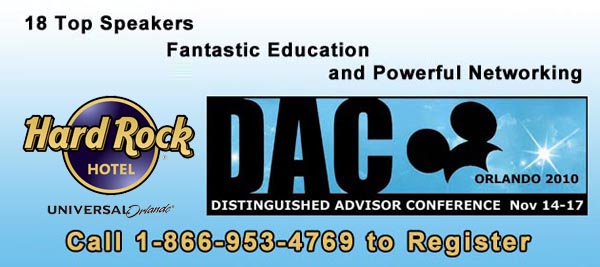
Mark Your Calendar: DAC - Great Venue! Hard Rock Hotel, Orlando
Featured Faculty: Basic Bookkeeping - As Easy as 1-2-3
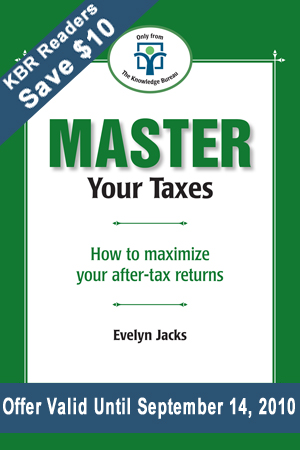
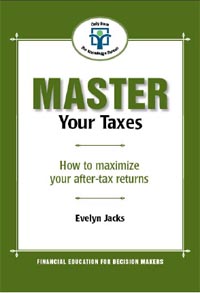
Featured Course: Master Your Taxes: How to Maximize Your After-Tax Returns
Knowledge Bureau in the News: DAC - Great Venue! Hard Rock Hotel, Orlando
► Don't Miss National Workshop Tour with Evelyn Jacks
 
BREAKING NEWS
 Robert Ironside Comments On The Current Global Economy

Robert Ironside, Ph.D., Knowledge Bureau faculty member, course author and financial professor discussed his views on the state of the economy in a recent interview with Knowledge Bureau President Evelyn Jacks.

Q. How can we think about investing into the best of the bad outcomes our current global economy is experiencing? Do you have any concerns that existing investments in "safe, guaranteed investments” are at risk?

A. 'I think the likely outcome will be recession followed by significant inflation as the only way the developed economies (probably led by Japan) can stave off an outright default (although this might still be several years in the future).

Remember, inflation is just another form of taxation. Any form of tax is a transfer of purchasing power from Party A to Party B. The inflation tax is a transfer of purchasing power from creditors to debtors. It works by reducing the purchasing power of the nominal dollars loaned out. Thus I buy a $1,000 bond today that matures ten years from now. If we have significant inflation between today and ten years from today, the bundle of goods and services that my $1,000 will purchase will shrink. This shrinkage is an effective confiscation of my wealth that is every bit as real as an income tax, but because it is so insidious, it can be imposed by the weakest of governments.

Therefore, in answer to your question, the major concern I have is about the erosion of wealth in fixed income securities. Many, many investors have moved significant portions of their portfolios into fixed income. In order to get yields above zero, many investors have started to lengthen out their maturies. If the securities have maturies beyond about five years, I think they are highly exposed to purchasing power risk (the loss of value due to inflation).

As to tax, that is a huge issue, because tax is levied on the nominal return, not the real return. Although investors should only be concerned with the real, after-tax return, most of them focus only on the nominal return. As inflation (and nominal returns) rise, the real, after-tax return falls in a linear fashion. It does not take much to produce a negative, real, after-tax return. The higher the nominal return, the more negative the real, after-tax return.”
 

Robert Ironside, ABD, PH. D is the author of several Knowledge Bureau certificate courses, including Financial Literacy: The Relationship Between Risk and Return

Mr. Ironside will headline the Distinguished Advisor Conference being held November 14-17th in Orlando, Florida, where the theme is "Focus on The Family".   View the entire agenda by clicking here.


Send To A Friendtop
 
 New Credit Card Regulations Provide Protection

The Minister of Finance, The Honourable Jim Flaherty has announced new regulations that have come into effect on September 1, 2010 that will help provide protection to Canadians and their use of credit cards.  One of the regulations that came into force provides a minimum 21 day interest-free grace period for credit card purchases when balances are paid in full. 

The application of the new regulations will relate specifically to those credit cards issued by banking institutions that are federally regulated. Regulations that came into effect earlier this year provided information to credit card customers related to interest rates and applicable fees, consent requirement for increases to credit limits and changes to debt collection practices. In addition to the interest free grace period, the new regulations will provide additional information to consumers through the following changes:

  • A breakdown of the time it would take to fully pay off outstanding debt if only the minimum monthly payment is made
  • Disclosure of all interest rate increases in advance to the credit card customer
  • Payment allocation would be changed to benefit the cardholder

Minister Flaherty advised that the change in regulations would "make financial products more transparent for consumers” and "will protect Canadians and their families from unexpected costs.”

To review the full new release, link here.
 

To keep current with all financial and economic news try the EverGreen Explanatory Notes DEMO TODAY! Or call us to subscribe: 1-866-953-4769.


Reply To This ArticleSend To A Friendtop
 
 Trend of Low Prescribed Rates Continues

The prescribed rates have been announced by CRA for the final quarter of 2010 and the trend of low interest rates continues on the same path we have seen for the past seven quarters.  These low prescribed rates - a 1% rate for certain taxable benefits and loans provides a great opportunity to use low-taxed corporate dollars to fund family income splitting, the purchase of new vehicles, new investments or to fund employer-required moves. Advisors should also consider speaking to their clients about opportunities for inter-spousal and shareholder loans with the rates that are currently available.
 
The Canada Revenue Agency announced the prescribed annual interest rates that will apply to any amounts owed to the CRA and to any amounts the CRA owes to individuals and corporate and non-corporate taxpayers. These rates are calculated quarterly in accordance with applicable legislation and will be in effect from October 1 to December 31, 2010.
 
Income tax
  • The interest rate charged on overdue taxes, Canada Pension Plan contributions, and Employment Insurance Premiums will be 5%.
  • The interest rate paid on overpayments by corporate taxpayers will be 1%.
  • The interest rate paid on overpayments by non-corporate taxpayers will be 3%.
  • The interest rate used to calculate taxable benefits for employees and shareholders from interest-free and low-interest loans will be 1%.

Other taxes

The interest rate on overdue and overpaid remittances for the following taxes will be:

Tax and Duty
Overdue remittances
Overpaid remittances
Corporate/Non-Corporate
GST
5%
1% / 3%
HST
5%
1% / 3%
Air Travellers Security Charge
5%
1% / 3%
Excise Tax (non GST)
5%
1% / 3%
Excise Duty (except Brewer Licensees)
5%
1% / 3%
Excise Duty (Brewer Licensees)
3%
N/A
Softwood Lumber Products Export Charge
5%
1% / 3%
 
 
Educational Resource:
 
For more information on tax planning provisions enroll in our Tax Efficient Retirement Income Planning, course one of the six courses that is part of the MFARetirement Income Services Specialist program. Register now and save.

Reply To This ArticleSend To A Friendtop
 
 Redirect Income Within The Family

With Canada's high personal tax rates, there is a great desire among taxpayers to find ways to save on taxes within the family unit, particularly where one spouse has a significantly higher income than the other.

Income splitting is the process of redirecting income within a family group to take advantage of the lower tax brackets, deductions and credits available to each family member.

Income is split by transferring income-earning assets from high-income to lower-income family members. Savings can be achieved in a number of ways: from strategies as simple as making interest free loans to making more complex arrangements involving corporations and trusts. There are three important characteristics of the Canadian tax system that make income splitting attractive to taxpayers:

  • Because of the progressive nature of our income tax system in Canada, marginal tax rates applied to taxable income rise as the individual's income increases.
  • The Canadian tax system taxes individuals rather than households. In addition, each individual has a basic personal tax credit, and pays no tax on income earned up to the amount that generates the credit. For 2010, the basic personal amount is $10,382.
  • Certain income sources are taxed more advantageously than others (capital gains and dividends are taxed at lower marginal rates than interest income).

Therefore, better tax results for the family unit as a whole can often be obtained when each individual in the family earns taxable income, as opposed to one person earning all of the income.

The Canadian Government is well aware of these potential tax savings and over time has enacted several rules to prevent it. The Attribution rules found in S. 74 and 75 of the Income Tax Act potentially apply whenever property is transferred or a loan is made at little or no interest to a family member.

Income Splitting Rules

Some important rules related to income splitting are as follows:

Transfers and loans to spouse or common-law partner

If an individual transfers or loans property either directly or indirectly, by means of a trust or any other means to the spouse or common-law partner for that person's benefit, any resulting income or loss from that property is taxable to the transferor. An exception to this rule is made if a bona-fide loan is made and interest paid at the prescribed rate or more (S. 74.1(1)).

Example: Inter-spousal Interest-free Loan

Issue: Bob makes an interest-free loan to his wife, Sue, of $50,000. Sue then invests the $50,000 in bonds so she can earn interest income. She will pay less tax than if Bob had invested the money, as she is in a lower tax bracket. Will this strategy work?

Answer: No. Loans to a spouse/common-law partner are subject to attribution where any income or loss from property is realized from the loan proceeds. Had the loan been made to earn income from a business that Sue runs, however, the business income would not be attributed.

Assignment of CPP Benefits

A specific exception to this rule surrounds the assignment of Canada Pension Plan (CPP) benefits to a spouse, which is allowed and results in the reporting of those benefits by the spouse to whom they have been transferred.

Example: Splitting CPP Benefits

Issue: Ethel's CPP benefits are larger than Elwin's. They wish to equalize the amount that is reported on their tax returns by splitting CPP benefits equally. Is it possible to do so?

Answer: Yes. By making application with HRDC, Ethel and Elwin can split the CPP benefits to the extent that the benefits were earned while the couple was together. Further, attribution rules will not apply on income from property earned on CPP benefits that have been assigned to a spouse. Therefore, Elwin can invest the assigned CPP benefits and report resulting earnings in his own hands.

Election to Split Pension Income

Beginning with the 2007 tax year, taxpayers who receive pension income that is eligible for the pension income amount may elect to have their spouse report up to 50% of that pension income. This election affects how much pension income is reported by each spouse but does not involve the actual transfer of those funds and therefore does not result in any attribution.

Transfers and loans to minors

Where property is transferred or loaned either directly or indirectly to a person who is under 18 and who does not deal with the transferor at arm's length or who is the niece or nephew of the transferor, the income or loss resulting from such property is reported by the transferor until the transferee attains 18 years of age. An exception to this rule is made if a bona-fide loan is made and interest paid at the prescribed rate or more (S. 74.1(2)).

Example: Loan to a Non-Arm's Length Minor

Issue: Maggie lends $5,000 (interest-free) to her son, Tom (16), who invests in the bond market. This year, Tom earns $625 in interest income from those bonds. How much income will Tom report on his tax return?

Answer: Nil. Attribution rules require the $625 earned by Tom to be reported by Maggie because the interest was earned by a minor, in a non-arm's-length transaction.

Gain or Loss Deemed That of Transferor

When property that is transferred to the individual's spouse or common-law partner earns taxable capital gains (or losses), such gains or losses will be reported by the transferor (S. 74.2(1))
 

Educational resources:For more information on tax planning provisions and compliance requirements, subscribe to The Knowledge Bureau's online tax reference for taxpayers, financial advisors and their clients: EverGreen Explanatory Notes.

Call: 1-800-953-4769 to order today.


Reply To This ArticleSend To A Friendtop
 
 YOUR NEWS
 Knowledge Bureau Poll
 

Current question

Do you feel that the economy has stabilized since the beginning of 2010?


Current poll results: Yes: 26%  No: 74%   Read what other readers have to say

 You Asked Us Using Home Buyers' Plan Withdrawals


Can I use a Home Buyers' Plan withdrawal to purchase a home for my disabled daughter?

 
The Home Buyers' Plan allows first time home buyers (or those who have not owned a home in the current year or preceding four years) to withdraw (under S. 146.01) , on a tax-free basis, up to $25,000 of funds saved within their Registered Retirement Savings Plan (RRSP) for the purpose of buying or building a home. No tax will be withheld on such withdrawals. The withdrawals may be a single amount or the taxpayer may make a series of withdrawals throughout the year as long as the total does not exceed the limit.
 
Tax-free withdrawals from an RRSP may also be made for the purpose of building or purchasing a compatible home to meet the needs of a disabled person.  If the home is for the use of a disabled person, the requirement that the buyer be a first-time buyer is not applicable.
 
For more tax tips, purchase a copy of Essential Tax Facts written by The Knowledge Bureau's President, Evelyn Jacks, to learn how to ace your 2009 tax return and save money all year long.   
 
In every edition of Knowledge Bureau Report, we will answer questions that people have sent to us with respect to various tax issues. Feel free to send any questions you have to reception@knowledgebureau.com, and look for our response in an upcoming issue of KBR.
Reply To This ArticleSend To A Friendtop
 
OUR NEWS
 Mark Your Calendar: DAC - Great Venue! Hard Rock Hotel, Orlando

 
Register Program Venue Accreditation

Hard Rock Hotel® Hard Rock Cafe International (USA) Inc. Universal elements and all related indicia TM & © 2010 Universal Studios. @2010 Universal Orlando. All rights reserved. ©Knowledge Bureau Inc. Distinguished Advisor Conference is owned by Knowledge Bureau Inc.
 
You'll also want to take in the nearby Wizarding World of Harry Potter!
 
WestJet Special Fares
 

We are pleased to offer all delegates attending the Distinguished Advisors Conference on November 14-17, 2010 a 10% discount off of WestJet's regular fares at time of booking (excluding web and special fares). Attendees must make their travel arrangements through the WestJet specialty sales team 1-877-952-4696 and quote account # C6632. Discounted rates are available 3 days prior and 3 days after the ev


Reply To This ArticleSend To A Friendtop
 Featured Faculty: Basic Bookkeeping - As Easy as 1-2-3

Of Special Interest to Bookkeepers, Accounting Firms, and Small Businesses


Students will optain a sound working knowledge on how to set up a CRA-compliant bookkeeping system for a small business, analyze and report transactions within the accounting cycle in a double-entry bookkeeping system, present financial statements to the accountant for tax preparation and review, and prepare bank reconciliations and simple payroll records, all featuring step-by-step guidance for using Simply Accounting.

is part of the
program.

View course brochure

Enrol now and SAVE $50
until September 14, 2010
or call for personal assistance
(1-866-953-4769)

Reply To This ArticleSend To A Friendtop
 Featured Course: Master Your Taxes: How to Maximize Your After-Tax Returns

Author Evelyn Jacks shows you how to Master Your Taxes
 

Mastering your taxes involves to pain points: time and money! No one has a lot of time, and getting the right assistance can be expensive. Master Your Taxes by author Evelyn Jacks will help you soothe the pain by showing you simple principles to save time and money on your largest lifetime expense--taxes!

TARGET AUDIENCE: Anyone who wants to understand the tax implications of life choices and beat the fear of the unknown: a large and unexpected tax bill.

EVELYN JACKS, is an international speaker, educational publisher and best-selling author. This is her 42nd book, focused on the subject of personal tax, financial planning, leadership and team management in creating real wealth. She is well-known by millions as Canada's most trusted tax author and commentator on issues relating to tax and personal finance. She has participated as an advisor to governments on tax policy and design.

Price: $24.95 SAVE $10 if you buy before September 14 ONLY $14.95

  • Understand the real impact of taxes on your income and capital.
  • Learn to pay yourself first.
  • Know how to split income with family members.
  • Learn the basic principles of tax free and tax efficient investing.
  • Take advantage of tax deferrals.
  • Gather the right information and ask the right probing questions.
  • Structure your affairs - legally - to beat the taxman.
  • Annual updating - cut through the details and make it work for you!

Reply To This ArticleSend To A Friendtop
 Knowledge Bureau in the News: DAC - Great Venue! Hard Rock Hotel, Orlando

 
Register Program Venue Accreditation

Hard Rock Hotel® Hard Rock Cafe International (USA) Inc. Universal elements and all related indicia TM & © 2010 Universal Studios. @2010 Universal Orlando. All rights reserved. ©Knowledge Bureau Inc. Distinguished Advisor Conference is owned by Knowledge Bureau Inc.
 
You'll also want to take in the nearby Wizarding World of Harry Potter!
 
WestJet Special Fares
 

We are pleased to offer all delegates attending the Distinguished Advisors Conference on November 14-17, 2010 a 10% discount off of WestJet's regular fares at time of booking (excluding web and special fares). Attendees must make their travel arrangements through the WestJet specialty sales team 1-877-952-4696 and quote account # C6632. Discounted rates are available 3 days prior and 3 days after the ev


Reply To This ArticleSend To A Friendtop
 Don't Miss National Workshop Tour with Evelyn Jacks

Media Passes Available: Contact The Knowledge Bureau toll free: 1-866-953-4769.

Join us for a concentrated, focused day on issues of concern to taxpayers, investors and professional planners in major centres across North America. At this time, we run workshops two times each year: January and November.

The Knowledge Bureau workshops are designed to be a solid investment of your time and money. The sessions begin with 8:00 a.m. registration, session begins promptly at 8:30, provide a one-hour break for lunch and end promptly at 4:00 p.m. They are structured to cover taxation topics in the morning and wealth management topics in the afternoon.


The dates are:

November Tax Planning Workshops:
Strategies for Individuals and Business Owners
Nationwide Workshop Tour Dates and Venues
 
Date City Venue
November 3 Winnipeg The Manitoba Club
November 4 Calgary Coast Plaza
November 5 Vancouver Terminal City Club
November 8 Toronto Airport Crowne Plaza Toronto Airport
November 9 Ottawa Southway Inn


January 2011 Annual Line-by-Line T1 Tax Update
Nationwide Workshop Tour Dates and Venues


Date City Venue
January 11 Winnipeg The Manitoba Club
January 12 Calgary Coast Plaza
January 13 Edmonton Petroleum Club
January 14 Vancouver  Terminal City Club
January 17 Toronto Airport Crowne Plaza AToronto Airport
January 18 Ottawa Southway Inn
January 19
 
January 20        
Montreal 

London
 
 
TBA
 
The London Club


Reply To This ArticleSend To A Friendtop
Published by
The Knowledge Bureau
Evelyn Jacks, Managing Editor
Knowledge Bureau Faculty
Try it - It's Free
MARK YOUR CALENDAR
Register by October 31
REGISTER BY SEPT. 15
Distinguished Advisor Conference
November 14-17
Orlando, FL

Call to register: 1-866-953-4769 to inquire

DAC 2010 Sponsors

LEAD SPONSOR

EXCLUSIVE MEDIA SPONSOR

Platinum Sponsor

Gold Sponsors


Silver Sponsor

Paper Sponsor

Associate Sponsors


Order Now