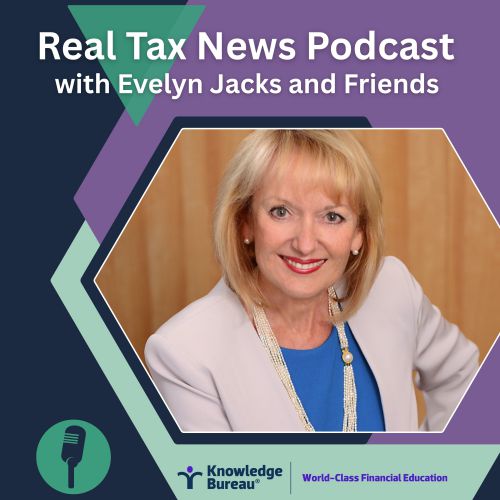
When CRA officially opened the electronic floodgates on tax filing season on February 23 this year, it was with a number of pieces of news. Did you know, for example, that the GST/HST Credit has now been officially renamed the Canada Groceries and Essentials Benefit (CGEB)? You get it by filing a tax return and interacting with CRA’s new digital services, which unfortunately still refer to the old name – the GST/HST Credit. It’s just one of those “game changers” that make Real Tax News with Evelyn Jacks and Friends, starting this week for its second season, so valuable to Canadians.
In February we asked KBR readers to weigh in on the following poll question: “The RRSP deadline for the 2023 tax year is February 29. From a wealth planning perspective, do you think middle aged Canadians should invest in a TFSA instead?”. The opinions were mixed with 64% answering “yes” in favour of the TFSA over the RRSP. As always, the important details are in the insightful comments left by our readers from the tax, accounting and financial services, and many pointed out it depends on “Know Your Client”. Check them out:
How does a person know whether a trust exists or not? The answer to that question can at times be more complicated than you’d imagine. There are occasions where a written document, such as a Will, very clearly purports to establish a “trust” but fails to do so. There are other occasions where there is no written document present at all, but nonetheless a trust relationship is deemed at law to have arisen. In some provincial jurisdictions, a trust to hold land cannot be validly created unless there is a written document in place.
It’s a question we are often asked and we are proud to tell you why Knowledge Bureau may provide the perfect career, training or entrepreneurial solution you or your firm may need at this moment. Knowledge Bureau is a certified, national post-secondary educational institute which provides world class business education and continuing professional development to advisors in the tax, accounting and financial services and vocational training to those who wish to enter these industries.
Now is the time to leap into new educational options with selected certificate courses for only $495 – today only! Your choice: Bookkeeping in a Digital World or Understanding Business Valuation. Learn more about the curriculum of these engaging programs as you start or continue your pathway to DMA™ Designation. Use code: 24LEAP. Cannot be combined with any other tuition offer. All taxes extra.
A trust, unlike a person or a corporation, is not a legal entity... A trust is simply a legal relationship between the trustee, who holds legal title to the subject property of the trust and the beneficiaries, who hold beneficial title to that subject property. However, there is one exception to the general rule: a trust is a legal entity for tax purposes. Subsection 104(2) of the Income Tax Act (Canada) specifically provides that a trust is an individual for tax purposes and, thus, is considered a separate taxpayer.
Knowledge Bureau has a new CE Solution for financial advisors and you can even take one of them for free. But that’s not the main reason you’ll want to check out our CE Savvy™ Micro-Course Collections! The education is fantastic and the new learning platform is amazing. Firms are signing up, and independent advisors, too. Here’s why Tony Mahabir, MBA, CMC, RWM, CIM, RRC, CFP, FP Canada Fellow and President of the CANFIN Group of Companies and is so enthused:
 In February we asked KBR readers to weigh in on the following poll question: “The RRSP deadline for the 2023 tax year is February 29. From a wealth planning perspective, do you think middle aged Canadians should invest in a TFSA instead?”. The opinions were mixed with 64% answering “yes” in favour of the TFSA over the RRSP. As always, the important details are in the insightful comments left by our readers from the tax, accounting and financial services, and many pointed out it depends on “Know Your Client”. Check them out:
 How does a person know whether a trust exists or not? The answer to that question can at times be more complicated than you’d imagine. There are occasions where a written document, such as a Will, very clearly purports to establish a “trust” but fails to do so. There are other occasions where there is no written document present at all, but nonetheless a trust relationship is deemed at law to have arisen. In some provincial jurisdictions, a trust to hold land cannot be validly created unless there is a written document in place.
 It’s a question we are often asked and we are proud to tell you why Knowledge Bureau may provide the perfect career, training or entrepreneurial solution you or your firm may need at this moment. Knowledge Bureau is a certified, national post-secondary educational institute which provides world class business education and continuing professional development to advisors in the tax, accounting and financial services and vocational training to those who wish to enter these industries.
 Now is the time to leap into new educational options with selected certificate courses for only $495 – today only! Your choice: Bookkeeping in a Digital World or Understanding Business Valuation. Learn more about the curriculum of these engaging programs as you start or continue your pathway to DMA™ Designation. Use code: 24LEAP. Cannot be combined with any other tuition offer. All taxes extra.
 A trust, unlike a person or a corporation, is not a legal entity... A trust is simply a legal relationship between the trustee, who holds legal title to the subject property of the trust and the beneficiaries, who hold beneficial title to that subject property. However, there is one exception to the general rule: a trust is a legal entity for tax purposes. Subsection 104(2) of the Income Tax Act (Canada) specifically provides that a trust is an individual for tax purposes and, thus, is considered a separate taxpayer.
 Knowledge Bureau has a new CE Solution for financial advisors and you can even take one of them for free. But that’s not the main reason you’ll want to check out our CE Savvy™ Micro-Course Collections! The education is fantastic and the new learning platform is amazing. Firms are signing up, and independent advisors, too. Here’s why Tony Mahabir, MBA, CMC, RWM, CIM, RRC, CFP, FP Canada Fellow and President of the CANFIN Group of Companies and is so enthused: