Year-End Tax Planning: After the Mid Terms
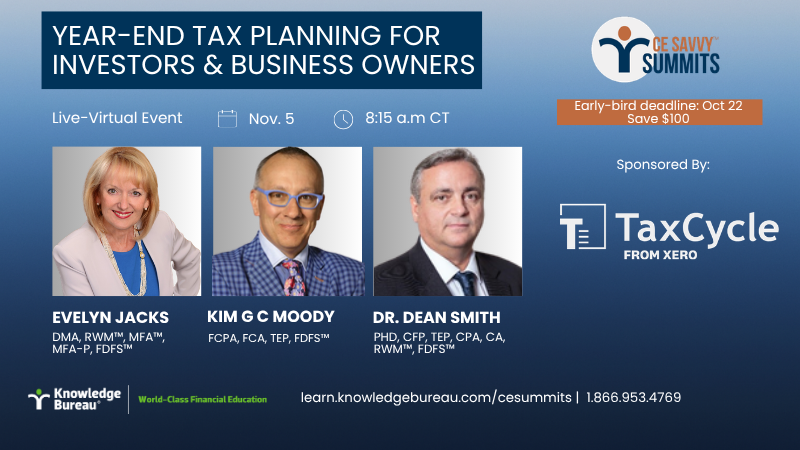
Advisors working with individuals, investors and business owners, the final months of 2026 bring together personal tax changes, investment decisions, owner-manager compensation, cross-border considerations, charitable giving and planning for retirement and estates. This year is particularly interesting as the world braces for the results of the U.S. Mid terms on November 3. For these reasons, Knowledge Bureau has assembled a Tax Powerhouse for its November 5 CE Savvy Summit. Register by October 22 to hear and learn from these experts:
The Overview: Year-End Tax Planning 2026 for Investors and Business Owners, will feature personal tax expert Evelyn Jacks, cross border expert Dean Smith and corporate owner-manager tax expert Kim G C Moody. The live virtual program provides a full day of advanced technical education, accompanied by a five-chapter online course and 20 CE/CPD credits.
Start with the 2026 Tax Changes
Evelyn Jacks will open the Summit with Year-End Tax Planning for Individuals, Investors and Business Owners, examining how tax law changes in 2026 affect year-end decisions.
The discussion will put particular emphasis on tax-saving opportunities that can be missed when significant lifecycle events occur, including education, severance, retirement, incapacity and the death of a taxpayer.
The timing also puts the November 5 Summit in a unique position: the agenda anticipates incorporating developments from the November 2026 Federal Budget, making the latest tax changes part of the day’s discussion.
Cross-Border Planning in Volatile Times
Cross-border considerations are another important part of the year-end checklist.
Dean Smith will examine the tax implications that can arise when Canadians travel, work, invest, own real estate or spend significant time in the United States.
His session will address residency and taxation, cross-border employment and pensions, snowbirds, offshore assets, U.S. real estate and investments, and year-end considerations for Canadian business owners with interests in the U.S.
Smith will also lead a comprehensive update on year-end charitable giving, looking at planning opportunities during life, at death and through estates and trusts. This includes donation credits and limits, gifts in kind, donations on death and planning involving Graduated Rate Estates.
Owner-Managers: From Acorns to Oaks
For entrepreneurs, tax efficiency must be considered throughout the lifecycle of the business—not simply when it is time to sell.
In Acorns to Oaks: Tax Issues in Owner-Manager Compensation Planning, Kim G C Moody will examine strategies and tax issues from business inception through succession.
The extensive discussion includes when to incorporate, salary and dividend planning, personal-corporate tax integration, hiring family members, taxable benefits, shareholder loans, capital dividends, holding-company structures, the Lifetime Capital Gains Deduction and intergenerational business transfers.
Building Tax Expertise Within the Workplace
Keeping up with these increasingly interconnected issues is also creating a training challenge for firms: how do you build more advanced tax capability within the team?
Knowledge Bureau has introduced a new Workplace Diploma option that provides another pathway for employers to develop that expertise. Team members can combine two DMA-Specialist™ courses with the Advanced T1 Tax Update into a focused workplace training program, allowing firms to align professional development with the knowledge their people need in their roles.
This creates an opportunity to take learning from a CE Summit and build on it with more structured technical education, particularly for organizations looking to develop specialists who can support colleagues and increasingly complex client needs.
Weigh in and take the survey! Not sure where to start? Fill out this short survey, and we’ll contact you to develop a custom training plan!
Next Up: The Advanced T1 Tax Update
The learning continues into tax season! On January 20, 2027, the next CE Savvy Summit turns its attention to the Advanced T1 Personal Tax Update, providing another opportunity to get up to date before the 2027 filing season.
The November and January programs are also part of the Senior Tax Specialist Diploma, a five-Summit pathway that continues with advanced retirement and estate planning, audit defence, and business growth and succession planning. Participants can enter the program at any point and complete the programs concurrently.
The Bottom Line
Year-end is an important opportunity to look beyond individual transactions and consider the client’s complete tax and financial picture. From personal tax changes and cross-border exposure to charitable giving and owner-manager compensation, the decisions made before December 31 can have implications well into the new year.
The November 5 CE Savvy Summit provides an opportunity to update that knowledge now, and, through the Workplace Diploma, January Advanced T1 CE Summit and Senior Tax Specialist Diploma, continue building deeper tax expertise for the year ahead.
Early-bird registration for the November 5 CE Savvy Summit is available until October 22.
 Help & Contact: 1 866 953 4769