Year-End Charitable Giving: Important Tax Planning Opportunities for Individuals, Estates and Trusts

Charitable donations can provide valuable tax planning opportunities, but the rules differ depending on whether gifts are made by individuals, spouses, estates or trusts. How are donation tax credits calculated, what limits apply, and how are gifts treated in the year of death?
These questions will be examined by Larry Frostiak, FCPA, FCA, CFP, TEP, RWM™, FDFS™, at the November 5 CE Savvy Summit: Year-End Tax Planning for Investors and Business Owners.
His session, “Focus on Donations: Gifts by Individuals, by Estates and Trusts,” will provide a comprehensive update on year-end donation strategies, including planning opportunities 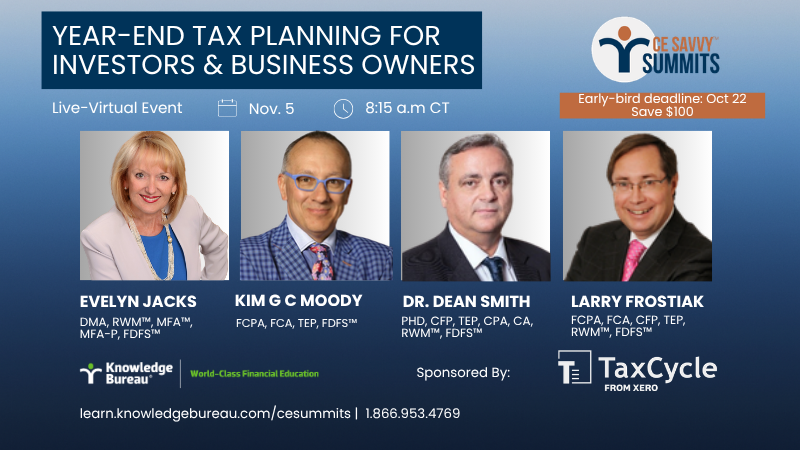 during life, at death and beyond.
Gifts by Individuals and Spouses
Using a case study approach, Larry will review federal and provincial non-refundable donation tax credits, donation limits and gifts to registered charities and other qualified donees, including government bodies.
The session will also examine:
- Cash donations versus gifts in kind
- Cultural and ecological gifts and gifts by artists
- Restrictions and advantage rules
- Optimizing donation claims between spouses
- Donation carryforwards, including in the year of death
Gifts on Death of a Taxpayer
What happens when charitable donations are made through a will, registered account or life insurance policy?
Larry will examine the rules governing donations made at death, including determining whether gifts are claimed on the deceased taxpayer's final return, a trust return or by the estate.
The discussion will also cover designation donations, including direct distributions from registered accounts and life insurance policies, and the special rules that apply to charitable gifts following death.
Gifts by Trusts and Graduated Rate Estates
Charitable donations made by estates and trusts are subject to additional rules, including provisions governing the timing and carryforward of donation tax credits.
Larry will examine how an estate may claim donation credits in the year of the gift or in subsequent years, as well as special rules for ecological gifts.
The session will also address circumstances in which eligible donations may be carried back to offset taxes arising from deemed dispositions on a deceased taxpayer's final return, including planning scenarios involving Graduated Rate Estates (GREs), single taxpayers and survivors.
The Bottom Line
Understanding the rules for charitable donations made during life, at death and through estates and trusts is an important part of year-end tax planning.
Larry's session will provide a technical review of donation credits, limits, carryforwards and special rules, with practical case studies for tax and financial advisors, including those holding or pursuing the MFA-P™ designation.
Join Larry Frostiak on November 5 at Knowledge Bureau's CE Savvy Summit: Year-End Tax Planning for Investors and Business Owners, also featuring Evelyn Jacks, Dr. Dean Smith and Kim G C Moody.
The live virtual Summit includes recordings, a five-chapter online course, EverGreen Explanatory Notes and 20 CE/CPD credits.
Early-bird savings end October 22.
Explore the November 5 CE Savvy Summit
 Help & Contact: 1 866 953 4769