KBR Poll: Tax and Financial Pros Split on Role of A.I. Leap

The Knowledge Bureau Report August Poll asked tax accountants and financial advisors to opine on how A.I. emerges to change the landscape in their industry; specifically, will it change how professionals create financial peace of mind in their communities?
Close to 55% said yes, but as important is that 45% said no. As usual, it was the astute commentary of the respondents that showed the mindset of the professional community in the heartland of Canada. Check it out:
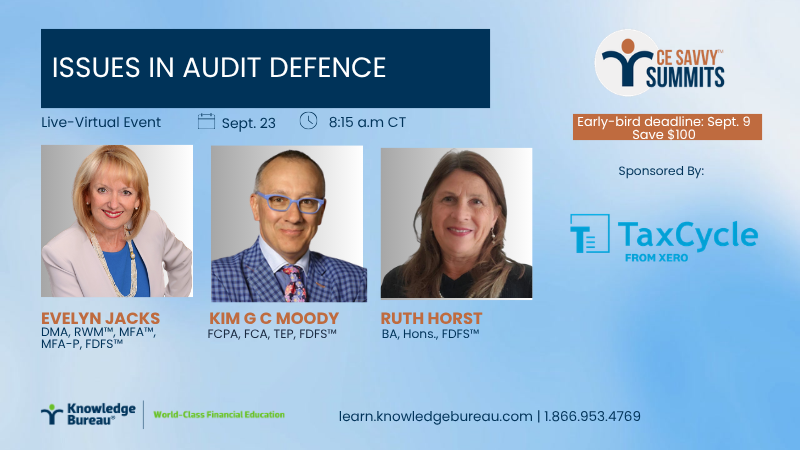
The results are particularly timely as the September 23 CE Savvy Summit: Audit Defence Management examines the growing use of AI in CRA audit activity and the increasingly important role of human oversight, professional knowledge, wisdom and judgement.
Guest Faculty Member Kim G C Moody’s session, “The AI-Astute Advisor: Countering AI Audits with Wisdom and Judgement,” for example, will examine algorithmic bias, incorrect targeting and privacy concerns, along with the critical role advisors play in bringing knowledge, experience and judgement to increasingly technology-driven audit processes.
Evelyn Jacks, President of Knowledge Bureau, will kick off the CE Summit with the important tax changes to expect for the 2026 tax filing year together with the issues most apt to be audited in the 2023, 2024, and 2025 years.
Increasing Use of AI at CRA: As CRA increasingly uses AI algorithms to analyze tax returns and compare data amongst other tax filers and third party data, such as e-transfers, cryptocurrency transactions and data integration to identify potential audit targets, advisors will need to understand not only what the technology can do, but how to apply professional judgement when its conclusions are wrong.
Tax Collections Ramp Up with Electronic Help. More specifically, CRA has noted in its Departmental Plan 2026-2027, that it will “Leverage AI to develop a platform to assist collections officers with the research and analysis of files, which will increase efficiency and resolution of tax debt.” To that end it plans to adopt e-delivery for collection notices.
CRA has also pledged, amongst other initiatives to do the following:
- Disabled People. CRA will digitalize the Disability Tax Credit paper application process.
- Simple Returns: Prepare a pre-filled tax return in CRA’s My Account for about 1 million lower‑income individuals, starting the 2026 tax year (2027 tax filing season).
- First Time Homebuyers: Deliver communication products and tailored processes for rebates of GST or the federal portion of HST for First-time Home Buyers.
- All Canadians: Launch the GenAI chatbot Charlie on Canada.ca and also in My Account.
- Administration. CRA’s 2026 Accessibility Progress Report will be published on Canada.ca. CRA will also launch enhancements to the Submit Documents online service to improve processing efficiency. This will include a new service that allows business tax filers to attach documents to forms completed on Canada.ca, and ensure those attachments are safe for use by the CRA. CRA also plans to enhance existing Gen AI tools for its internal use to increase productivity and operational efficiencies.
Following are some of the comments from our poll respondents in August.
AI Should Be a Tool, Not the Decision Maker: Vincent M. Saab offered a more detailed perspective on where AI can add value, and where its role should stop: “AI is rapidly becoming a new standard; this does not mean we have to let it control our decisions. In my opinion financial peace of mind is knowing everything is done per established standards, rules and guidance. We do not need AI to lead us through these. The danger is when AI starts replacing human beings, this will lead to a total change in human behavior. If AI is used as an intelligent search engine and the results are compared to our knowledge and understanding of the issues in front of us, it could help in providing financial peace of mind, but we should never let AI be the decision maker.”
A Starting Point for the Professional: Joseph A. Truscott, CPA, doesn’t believe AI changes the fundamental role of the professional, but sees considerable value in using it to support that role: “I do not think AI will change matters as far as your question. However AI is a great tool to use and it broadens the skills of a CPA with its responsiveness of replies and supporting information to use as a starting point.”
How We Find Information is Changing: Ina Turner reflected on how dramatically the process of finding answers to tax and financial questions has already changed—and why professionals still need deep knowledge to assess the information their clients come to ask them: “We get random information (online) so we need to study to know what the answers are; maybe this is just going to improve on skills and knowledge.”
The Bottom Line:
Whether AI changes the professional’s fundamental role or simply proves to be a powerful new tool, readers appear to agree on one important point: technology does not replace professional judgement in the quest to help clients find financial peace of mind over the long term.
But, as AI becomes more prevalent in CRA’s tax administration and communication, there may be a profound effect on year round services required of professional tax practices and financial services. Knowing how to question, interpret and apply the law to the information channelled by CRA and its AI tools may become an increasingly important part of an advisor’s role, especially in mitigating tax risk.
Thanks to those who participated, for this month’s poll we’re asking:
“In your view is a comprehensive personal and corporate tax reform necessary to make Canada's economy stronger in response to trade wars?”
Weigh in here!
 Help & Contact: 1 866 953 4769