Year-End Tax Planning 2026: What Tax-Saving Opportunities Are Clients Missing?
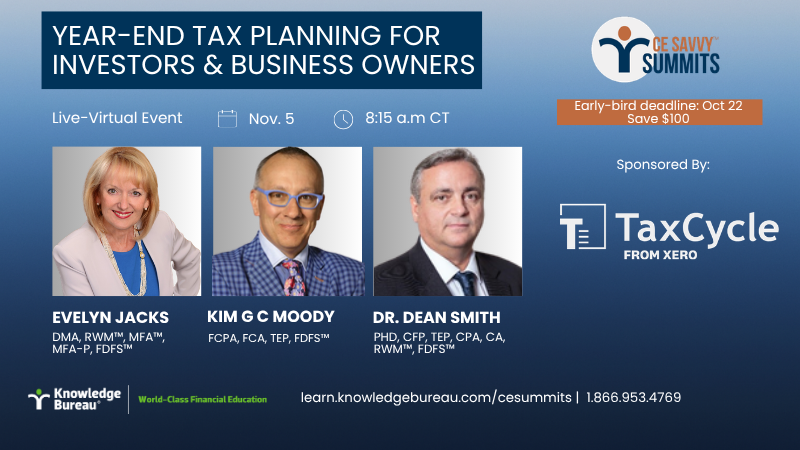
Canada federal budget cycle was permanently shifted to the fall last year and so it is expected that Budget 2026 will likely follow last year’s November 4 cadence. This, together with the result of the U.S. midterms to consider, will make year end tax planning for corporate owner-managers very interesting this year. What should be on the year-end checklist you share with your clients? Evelyn Jacks, President of Knowledge Bureau, will provide a comprehensive overview as she opens the November 5 CE Savvy Summit: Year-End Tax Planning for Investors and Business Owners. Register by October 22 early bird offers. Here’s what’s in store:
Year-End Tax Planning for Individuals, Investors and Business Owners, will focus on changes announced in the budget, or if it has not yet been tabled, the changes that should be considered. A thorough review of tax changes that have been legislated for 2026-2027 will be presented, along with tax-saving opportunities that individual taxpayers may overlook, particularly when navigating important financial life events.
For business owners and investors, critical analysis of key provisions that remain unindexed will be considered including the increasing tax cost of
- Never indexed: the $200 charitable donation limit, and the $5000 tuition transfer amount
- The small supplier threshold for GST/HST purposes – unchanged since 1991
- The CPP basic exemption, unchanged since 1996
- The foreign asset thresholds, unchanged since 1998
- The pension income amount, unchanged since 2006
- RDSP maximum contribution limitations, unchanged since 2008
- The corporate small business limit, unchanged since 2009
- The child care expense limits, unchanged since 2015
- Tax bracket de-indexing emerging in various provinces
Tax Planning Beyond the Annual Return
These realities make year end tax planning a more valuable exercise as times of investments, income and expenses, wherever possible, can beat inflationary taxes. Evelyn's session will explore five important lifecycle events where year end tax planning deserves particular attention:
- Education
- Severance
- Retirement
- Incapacity
- Death of a Taxpayer
Integrating the Latest 2026 Tax Changes
Another important consideration is how changes to tax legislation affects existing planning strategies. With the November 2026 Federal Budget anticipated soon after the CE Summit, Evelyn will examine anticipated developments and their potential implications for individuals, investors and business owners.
For advisors, this means looking beyond the announcements themselves to consider how changing tax rules may influence year-end recommendations, financial decisions and future planning opportunities. The objective is to identify where tax savings may be available, where existing strategies may need to be revisited and what clients should be considering before the year ends.
Bringing Year-End Planning Back to the Client
Tax planning is most valuable when it connects technical knowledge with a client's broader financial circumstances.
An employment transition may affect retirement planning. A change in family circumstances may introduce new estate planning considerations. A business owner's decisions about income and investments may have consequences for both personal and corporate taxation. Strategic philanthropy may be top of mind for high net worth clients. A cash flow crunch could swerve into a potential insolvency.
Are you adding value by being on top of these issues in your communications?
The Bottom Line
Year-end planning is an opportunity to save your clients large sums in personal taxation. Understanding the latest tax changes and recognizing the implications of major lifecycle events can help advisors identify tax-saving opportunities and provide more comprehensive advice to clients.
Join Evelyn Jacks on November 5 for the opening session of Knowledge Bureau's CE Savvy Summit: Year-End Tax Planning for Investors and Business Owners, followed by advanced technical sessions on corporate, cross border and strategic philanthropic planning.
The live virtual Summit includes an accompanying five-chapter online course, recordings, EverGreen Explanatory Notes and 20 CE/CPD credits.
Early-bird registration savings are available until October 22, 2026. Check out the detailed agenda and registration options for individuals and groups.
Explore the November 5 CE Savvy Summit
 Help & Contact: 1 866 953 4769